The four phases of the menstrual cycle
Overview
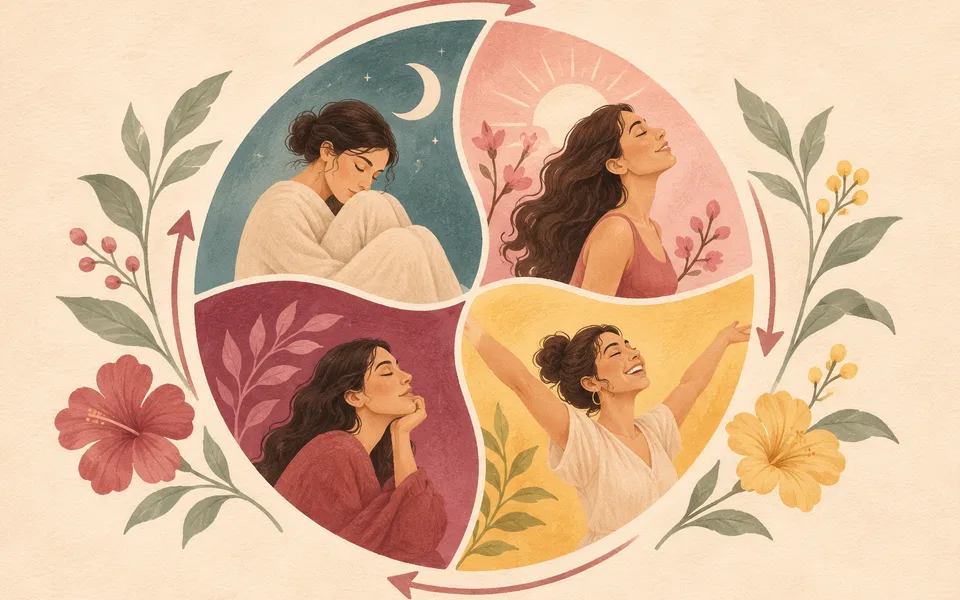
Your cycle has four phases: your period, the egg-growing phase, ovulation, and the phase after ovulation. Each has different hormones, and you may notice different energy and moods.
Key points
- The four phases are menstrual, follicular, ovulation and luteal.
- The time before ovulation can change from cycle to cycle. The time after ovulation stays fairly steady at 12 to 14 days.
- Mood and energy patterns are common but not the same for everyone.
The phases at a glance
| Phase | Typical timing (28-day cycle) | What is happening | What some people notice |
|---|
| Menstrual | Days 1 to 5 | Hormones are low. The womb lining is shed. | Cramps, tiredness, lower mood |
| Follicular | Days 1 to 13 | FSH helps an egg mature. Oestrogen rises and rebuilds the lining. | More energy, brighter mood |
| Ovulation | About day 14 | An LH surge releases the egg. The egg lives 12 to 24 hours. | Clear stretchy mucus, mild one-sided pain, higher sex drive |
| Luteal | Days 15 to 28 | Progesterone rises and prepares the lining for a pregnancy. | Breast tenderness, bloating, PMS symptoms, slightly warmer body temperature |
Some sources count the follicular phase as starting on day 1, so the period sits inside it. Others list the period as its own phase. Both are correct. Four phases is simply easier to follow.
What changes from cycle to cycle
The first half of the cycle is flexible. Stress, illness or travel can delay ovulation, which makes the whole cycle longer. The second half, after ovulation, is usually 12 to 14 days. That is why ovulation happens about two weeks before your next period, not always on day 14.
If your luteal phase is regularly shorter than about 10 days and you are trying to conceive, speak to your doctor.
Eating and exercising by phase
Many apps and websites suggest eating or training differently in each phase. Some people find this helpful. The evidence is limited, so treat it as a personal experiment and not a rule.
When to see a doctor
- Your periods are missing, very irregular, or very heavy.
- You bleed between periods.
- Your mood drops sharply every month in the week before your period, especially if
- you have thoughts of harming yourself. Seek help urgently.
- You are trying to conceive and your cycles are very short or long.
Summary
The four phases follow a predictable order, but their length and your symptoms are personal. Tracking a few cycles shows your own pattern.
What you record and what you estimate
- Menstruation
- Record the dates you actually bleed.
- Follicular phase
- This starts on the first day of the cycle, so it overlaps with menstruation at the beginning.
- Ovulation
- A calendar can estimate when this may happen. A predicted date does not establish when you ovulated.
- Luteal phase
- This phase follows ovulation. You can note symptoms here and compare how their timing changes over several cycles.
Keep observations and predictions labelled separately in your diary. Calendar predictions should not be used as contraception.
References
- Fehring RJ, Schneider M, Raviele K. Variability in the phases of the menstrual cycle. J
- Obstet Gynecol Neonatal Nurs. 2006.
- ACOG Committee Opinion No. 651. Menstruation in girls and adolescents: using the menstrual cycle as a vital sign. 2015.