Your first period: a guide for girls and parents
Overview
The first period usually comes around age 12 or 13, but anywhere from 9 to 15 is normal. The first cycles are often irregular. Being prepared makes it much less stressful.
Key points
- The first period (menarche) usually starts about 2 to 3 years after breasts begin to develop.
- Anything from age 9 to 15 is within the normal range.
- Cycles can be irregular for the first 2 to 3 years.
- Talking about it early helps girls feel calm and confident.
Signs that it is coming
- Breasts start to grow, usually 2 to 3 years earlier.
- Hair appears under the arms and in the pubic area.
- A clear or white vaginal discharge appears, often some months before the first period.
- A growth spurt.
What to expect
The first period often lasts 2 to 7 days. The blood can be red, pink or brown. It is usually light. Some girls have cramps, a sore back or mood changes. Others feel nothing special.
It is normal to skip months, or to have two periods close together, in the first years.
Period products
- Pads: the easiest place to start. Change every 4 to 6 hours.
- Period underwear: washable and comfortable.
- Tampons: safe for first periods if the girl wants them. Change every 4 to 8 hours and never leave one in overnight beyond 8 hours.
- Menstrual cups: usually better for older teens.
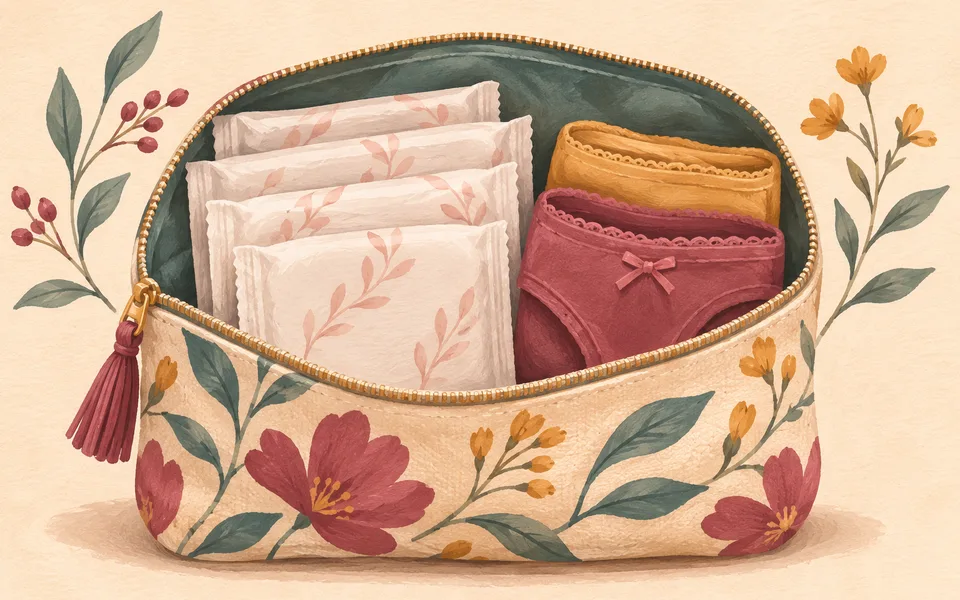
A small kit for the school bag helps: a spare pad, spare underwear, a bag for used products, and wipes.
Easing discomfort
A hot water bottle, gentle exercise and rest help. If pain relief tablets are needed, follow the instructions on the pack and ask a pharmacist or doctor which one is right for the girl's age and health.
For parents
- Start the conversation before periods begin. From around age 8 to 10 is a good time.
- Keep it calm and factual. Use the real words.
- Include boys and fathers in basic education so periods are not a secret.
- Many families also want guidance on prayer, fasting and other religious practice during periods. A trusted scholar or elder can help with this. The health facts here stay the same.
When to see a doctor
- No breast development by age 13.
- No period by age 15, or by 3 years after breasts started to develop.
- Periods or breast development starting before age 8.
- Very heavy bleeding, such as soaking a pad every 1 to 2 hours.
- Pain so bad that she misses school or normal activities.
- Periods lasting longer than 7 to 8 days, or cycles shorter than 21 days or longer than 45 days after the first 2 years.
Summary
The first period is a normal step in growing up. Preparation, a simple kit and an open conversation make it easier for everyone.
Put together a first-period kit
- A couple of wrapped pads or another product you know how to use.
- Spare underwear and a small bag for anything you need to take home.
- The name of an adult you can ask for help at school or away from home.
If you’re unsure what to say, try “I think my period has started. Can you help me find a pad and somewhere private to change?” At home, try putting a pad into a spare pair of underwear so you know how it fits before you need it.
References
- ACOG Committee Opinion No. 651. Menstruation in girls and adolescents: using the menstrual cycle as a vital sign. 2015.
- Marshall WA, Tanner JM. Variations in pattern of pubertal changes in girls. Arch Dis Child. 1969.
- NICE Clinical Knowledge Summary. Delayed puberty.